skip to main |
skip to sidebar
When I first became an apprentice of Sarah Head and joined her Springfield Sanctuary Group, last January, she assigned us the task of finding elder and harvesting the bark to make a salve for bruising. I wrote about harvesting elder bark and making the salve here. Now all we apprentices started furiously talking among ourselves, as none of us had ever heard of using elder bark for bruising, and Sarah kept quiet while we emailed back and forth and tried to figure out just why this would work. We all searched and search through old herbals and web sites and discussed the different constituents and all we could come up with was the fact it would be an anti inflammatory. Then I found in my book Indian Herbology of North America by Alma Hutchens where she referred to it for making a discutient ointment. Ah ha! Discutient herbs cause dispersal or disappearance of a pathological accumulation. So elderbark would cause the accumulated blood to disperse to be reabsorbed. Well I have proof of how well this works!
I recently took one hell of a fall. I was trying to step over a baby gate at my dad’s and when I went to place my foot on the floor on the other side, there was no floor! He has a sunken living room and I had forgotten! I went off balance, tumbling into the gate and onto the floor, knocking over a great pile of boxes they had stacked there, since they had just moved. Within a few short hours I had a horrible, swollen, hot, hurting bruise on my thigh! Being the empiricist I am, I decided to use only the elder bark salve on the bruise and document the progression of recovery. This photo is the second day after injury
 The pain and swelling had already gone down considerably and I was noting that this bruise never became as horrible as bruises usually do on my fair skin.
Bruise day 6. Amazing how the whole center of the bruise has became perfectly clear! The anti inflammatory properties had taken care of any pain completely.
The pain and swelling had already gone down considerably and I was noting that this bruise never became as horrible as bruises usually do on my fair skin.
Bruise day 6. Amazing how the whole center of the bruise has became perfectly clear! The anti inflammatory properties had taken care of any pain completely.
 Bruise day 9
 I think a factor on the fact there is still darkish areas, is I had trouble reaching those places and didn’t apply it as well. But still, remarkable, don’t you think?
Bruise day 13
I think a factor on the fact there is still darkish areas, is I had trouble reaching those places and didn’t apply it as well. But still, remarkable, don’t you think?
Bruise day 13
 Note all the perfectly clear skin! I was quite diligent to reach the hard to reach places and by the 15th day, there was absolutely no sign I had ever had an injury! Now I don’t know about you, but a bruise of this sort would have gone through a rainbow of colors during the healing process untreated and also would have been with me for well over a month. Truthfully, with my very fair skin, I would have seen it for closer to 6 weeks or longer without treatment.
So, I used the elder bark salve and have proven to myself that it is anti inflammatory and an amazing discutient. ( I am trying to figure out whether the word deobstruent would be appropriate also. A deobstruent herb is one that removes obstructions and allows the bodies fluids to flow. I am thinking yes. Any thoughts on this from my herbie friends would be appreciated.)As a side benefit of my treatment, I had a spider vein near this area, and I am continuing to experiment, but I am seeing it fade also. I will continue experiments with that aspect and start taking pictures, so I might have some adds about that to share with you in the future:)
Huge thanks to my mentor Sarah for teaching me about elder bark. Another usage for our wonderful elder tree with its myriad of miracle helping qualities!!
For those of you unfamiliar with elder and are trying to identify it in your local foraging area, I created this post. I know I will be harvesting more bark and making a lot of salve to keep on hand in my apothecary!
Herbal and Honey Hugs to all who visit Comfrey Cottages xx
Note all the perfectly clear skin! I was quite diligent to reach the hard to reach places and by the 15th day, there was absolutely no sign I had ever had an injury! Now I don’t know about you, but a bruise of this sort would have gone through a rainbow of colors during the healing process untreated and also would have been with me for well over a month. Truthfully, with my very fair skin, I would have seen it for closer to 6 weeks or longer without treatment.
So, I used the elder bark salve and have proven to myself that it is anti inflammatory and an amazing discutient. ( I am trying to figure out whether the word deobstruent would be appropriate also. A deobstruent herb is one that removes obstructions and allows the bodies fluids to flow. I am thinking yes. Any thoughts on this from my herbie friends would be appreciated.)As a side benefit of my treatment, I had a spider vein near this area, and I am continuing to experiment, but I am seeing it fade also. I will continue experiments with that aspect and start taking pictures, so I might have some adds about that to share with you in the future:)
Huge thanks to my mentor Sarah for teaching me about elder bark. Another usage for our wonderful elder tree with its myriad of miracle helping qualities!!
For those of you unfamiliar with elder and are trying to identify it in your local foraging area, I created this post. I know I will be harvesting more bark and making a lot of salve to keep on hand in my apothecary!
Herbal and Honey Hugs to all who visit Comfrey Cottages xx

One of the first tasks Sarah assigned to we Springfield Sanctuary year 1 folks, was to use elder bark to make a double infused bruise salve. First off is peeling the bark off
 It peels quite easily and soon I had quite a bit peeled.
Next was to divide this peeled bark roughly into two piles.
It peels quite easily and soon I had quite a bit peeled.
Next was to divide this peeled bark roughly into two piles.
 Half went into the top pan of my double boiler with enough olive oil to well cover the bark. This smaller pan is fitted into a slightly larger pan, partially filled with boiling water.
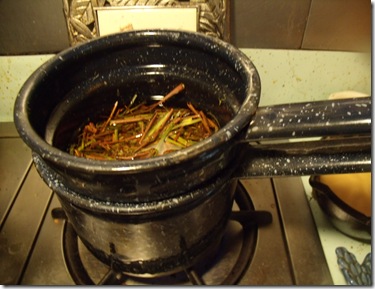 (A double boiler can be any sort of arrangement where you have a smaller pan that fits into a larger pan. The idea of one is to fill the bottom larger pan with water that is heated to a boil, while the smaller pan sits inside it holding the substance you are infusing or melting. They are wonderful for melting chocolate, wax or other things that if put directly on the source of heat, would either burn or possibly burst into flames! Care must be taken to not have the bottom pan have so much water in it that when boiling it splashes water into the upper pan though, so that is something to watch for. You must not walk away from a double boiler either, as vigilance must be maintained to make sure it does not boil dry!)
The elder bark was infused by this method for two hours, then strained through a piece of a clean old cotton pillow case, (use what you have folks! no need to go buy anything special). I let it cool a bit and then gave the cloth filled with this infused bark some good hard squeezes to get every bit out I could. The other half of the fresh bark was then placed in the top pan of the double boiler and the first infused oil was poured over this new bark and again, infused for two hours. (I did end up having to add a little bit more olive oil to the second batch to make sure the elder bark was covered.)
(A double boiler can be any sort of arrangement where you have a smaller pan that fits into a larger pan. The idea of one is to fill the bottom larger pan with water that is heated to a boil, while the smaller pan sits inside it holding the substance you are infusing or melting. They are wonderful for melting chocolate, wax or other things that if put directly on the source of heat, would either burn or possibly burst into flames! Care must be taken to not have the bottom pan have so much water in it that when boiling it splashes water into the upper pan though, so that is something to watch for. You must not walk away from a double boiler either, as vigilance must be maintained to make sure it does not boil dry!)
The elder bark was infused by this method for two hours, then strained through a piece of a clean old cotton pillow case, (use what you have folks! no need to go buy anything special). I let it cool a bit and then gave the cloth filled with this infused bark some good hard squeezes to get every bit out I could. The other half of the fresh bark was then placed in the top pan of the double boiler and the first infused oil was poured over this new bark and again, infused for two hours. (I did end up having to add a little bit more olive oil to the second batch to make sure the elder bark was covered.)
 Double infused elder bark oil
Sarah recommends that when you are using fresh plant material, it is best to wait three days to make sure any water content separates out.
The next thing was to make a bruise salve out of the oil. Using the double boiler method again, I heated the double infused elder bark oil in one pan and melted beeswax in another. You could just grate the beeswax right into the warming oil, if you prefer.
Double infused elder bark oil
Sarah recommends that when you are using fresh plant material, it is best to wait three days to make sure any water content separates out.
The next thing was to make a bruise salve out of the oil. Using the double boiler method again, I heated the double infused elder bark oil in one pan and melted beeswax in another. You could just grate the beeswax right into the warming oil, if you prefer.
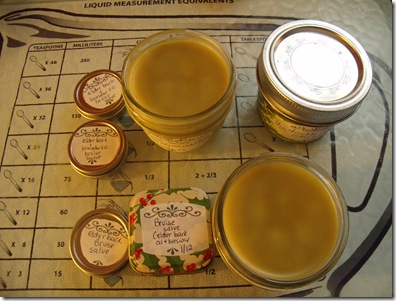
 The usual proportions used in salves is 1 ounce of melted beeswax to 8 ounces of warmed oil. I always work on a glass cutting board, so after the warmed oil and melted wax have been combined, I just put a bit on the glass, so it cools quickly, and I can see if I would like it either a bit firmer (add more wax) or a bit looser (add more oil). You can see my little test blob in this next picture
 When you have the oil and beeswax in the proportions you like, just pour into containers to cool.
My friend Marci, had given me some lovely lavender essential oil, so I added a few drops to part of the salve, as lavender eo is good for bruising also. The other part I just left plain though, as I am curious to see how the elder bark plain does with bruising and I like the smell of it just fine plain. In fact, I thought it smelled wonderful while heat infusing on the stove top! I have never used elder bark before, myself, have you? You haven’t?! Would you care to? Leave me a comment letting me know if you prefer to try a tin with or without the lavender essential oil and I will draw a name Saturday and mail the winner a tin to try!
When you have the oil and beeswax in the proportions you like, just pour into containers to cool.
My friend Marci, had given me some lovely lavender essential oil, so I added a few drops to part of the salve, as lavender eo is good for bruising also. The other part I just left plain though, as I am curious to see how the elder bark plain does with bruising and I like the smell of it just fine plain. In fact, I thought it smelled wonderful while heat infusing on the stove top! I have never used elder bark before, myself, have you? You haven’t?! Would you care to? Leave me a comment letting me know if you prefer to try a tin with or without the lavender essential oil and I will draw a name Saturday and mail the winner a tin to try!
 So just what is the structure and function of skin? And how does a bruise form?
Skin is our largest organ, covering approximately 20 square feet. It helps regulate our body temperature and allows us to have the sensations of heat, cold and touch. It helps protect us from the elements and microbes. It performs an essential role in respiration in the form of perspiration. Vitamin D synthesis also occurs here.
Skin is divided into three layers:
Epidermis – Outmost layer, creates our skin tone and a waterproof barrier (It might make you wonder when I said that skin is a waterproof barrier, how this salve will affect a bruise. Well skin might be a waterproof barrier, but it readily absorbs other things, like this oil/salve)
Dermis – Beneath the epidermis, contain hair follicles, sweat glands, and tough connective tissue
Hypodermis/Subcutaneous Tissue – The deepest layer, made from fat and connective tissue
Bruises form when small blood vessels under the skin tear or leak, most often caused by a bump or fall. Blood leaks into surround tissue, causing the black and blue color. As bruises (contusions) heal, they can change colors, as they heal, from purplish black, to reddish blue, or yellowish green. Initially, the bruise can appear quite red. It is the hemoglobin in the red blood cells, and the breakdown products of hemoglobin, that causes these colorful changes.
Most bruises are not cause for concern. You should be aware though, that if you have a severe bruise form, swelling and pain that begins within 30 minutes of an injury, you might have a sprain or fracture.
It is possible to get a bruise and not even remember what you did to cause it. As we age, we loose our some of the fat under our skin, causing it to be thinner and less flexible. This change, along with skin exposure, causes blood vessels to break easily. When blood vessels break, bruising happens.
Ladies are more prone to bruising than gentleman, especially in areas like the buttocks, upper arms and thighs. A tendency to bruise easily can even be a family trait.
Sometimes a bruise will travel in the direction of gravity, so a leg bruise might take longer to heal than one on the arm, for example.
Arnica , Calendula , and Comfrey are a few herbs which might also help heal a bruise. If you find you bruise easily, you might consider adding Bilberry to your diet. It helps strengthen and protect capillary walls, which makes it a good addition to help any bruise heal and to help prevent new ones.
Big Hugs to all who visit Comfrey Cottages xx
So just what is the structure and function of skin? And how does a bruise form?
Skin is our largest organ, covering approximately 20 square feet. It helps regulate our body temperature and allows us to have the sensations of heat, cold and touch. It helps protect us from the elements and microbes. It performs an essential role in respiration in the form of perspiration. Vitamin D synthesis also occurs here.
Skin is divided into three layers:
Epidermis – Outmost layer, creates our skin tone and a waterproof barrier (It might make you wonder when I said that skin is a waterproof barrier, how this salve will affect a bruise. Well skin might be a waterproof barrier, but it readily absorbs other things, like this oil/salve)
Dermis – Beneath the epidermis, contain hair follicles, sweat glands, and tough connective tissue
Hypodermis/Subcutaneous Tissue – The deepest layer, made from fat and connective tissue
Bruises form when small blood vessels under the skin tear or leak, most often caused by a bump or fall. Blood leaks into surround tissue, causing the black and blue color. As bruises (contusions) heal, they can change colors, as they heal, from purplish black, to reddish blue, or yellowish green. Initially, the bruise can appear quite red. It is the hemoglobin in the red blood cells, and the breakdown products of hemoglobin, that causes these colorful changes.
Most bruises are not cause for concern. You should be aware though, that if you have a severe bruise form, swelling and pain that begins within 30 minutes of an injury, you might have a sprain or fracture.
It is possible to get a bruise and not even remember what you did to cause it. As we age, we loose our some of the fat under our skin, causing it to be thinner and less flexible. This change, along with skin exposure, causes blood vessels to break easily. When blood vessels break, bruising happens.
Ladies are more prone to bruising than gentleman, especially in areas like the buttocks, upper arms and thighs. A tendency to bruise easily can even be a family trait.
Sometimes a bruise will travel in the direction of gravity, so a leg bruise might take longer to heal than one on the arm, for example.
Arnica , Calendula , and Comfrey are a few herbs which might also help heal a bruise. If you find you bruise easily, you might consider adding Bilberry to your diet. It helps strengthen and protect capillary walls, which makes it a good addition to help any bruise heal and to help prevent new ones.
Big Hugs to all who visit Comfrey Cottages xx

 The pain and swelling had already gone down considerably and I was noting that this bruise never became as horrible as bruises usually do on my fair skin.

 Note all the perfectly clear skin! I was quite diligent to reach the hard to reach places and by the 15th day, there was absolutely no sign I had ever had an injury! Now I don’t know about you, but a bruise of this sort would have gone through a rainbow of colors during the healing process untreated and also would have been with me for well over a month. Truthfully, with my very fair skin, I would have seen it for closer to 6 weeks or longer without treatment.